
Criminal Cases in Clarke County Courts
The Iowa District Court for Clarke County is the unified state trial court for local felony, misdemeanor, traffic, and ordinance cases within its jurisdiction. Clarke County sits in Judicial District 5, Election District 5B. Iowa abolished inferior municipal trial courts in 1973, so Osceola, Murray, and Woodburn do not keep separate city criminal court dockets.
The Clerk of District Court at 100 South Main Street in Osceola is the custodian for the court file. The clerk maintains the docket and public filings, supports courthouse terminal inspection, provides copies or certification, and receives eligible expungement filings. The court directory lists 641-342-6096 and fax 641-342-2463. Call before travel to confirm counter hours, current copy charges, payment terms, certification, and any retrieval delay for older material.
The Iowa Judicial Branch Clarke County directory identifies the court and clerk contact.
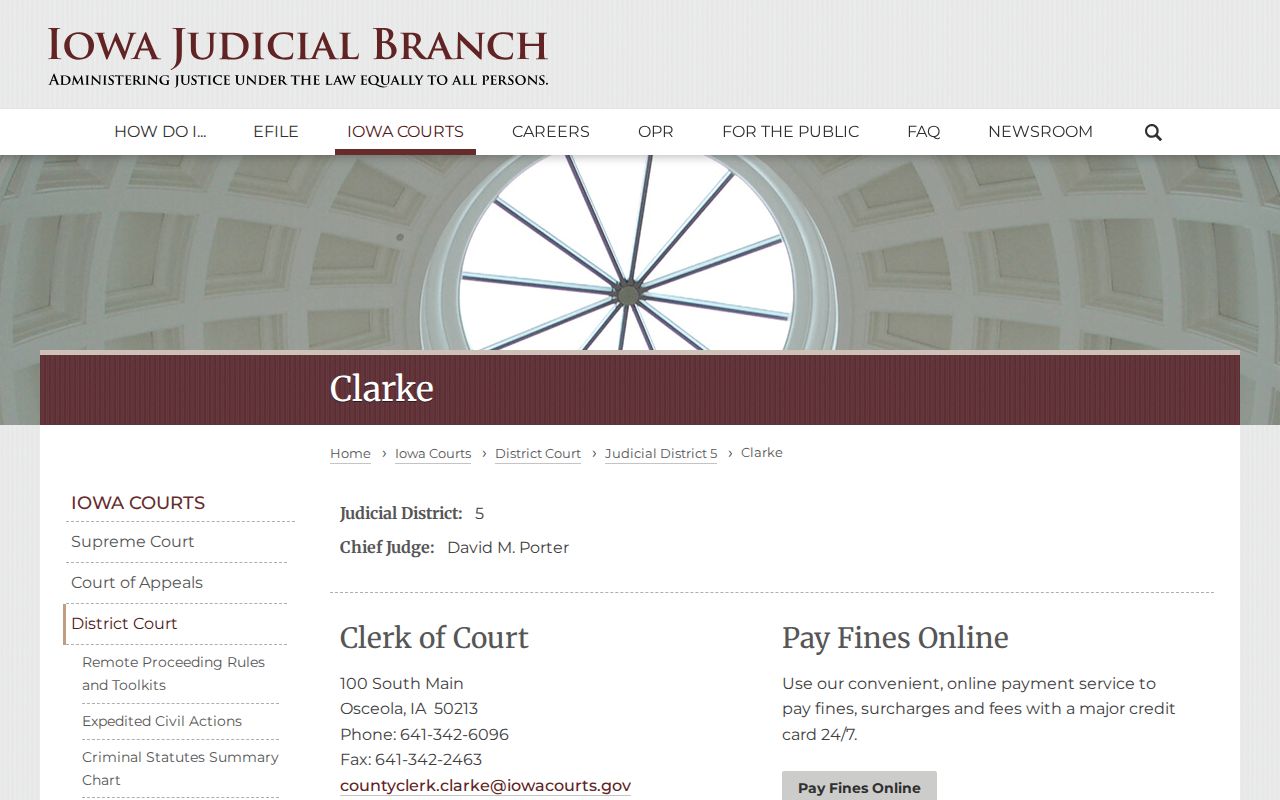
The official directory is the best source for local court contact, while Iowa Courts Online supplies the remote public docket.
Clarke County Court File Counter
Remote search and document access are not the same service. Iowa Courts Online acts as an index of cases and events. Public case documents can be viewed through a courthouse public-access terminal. An Advanced Search subscription adds query and detail modules, but it does not unlock document downloads. A reader who needs a complaint, trial information, order, judgment, or certified copy must use the clerk's document channel.
Bring the complete case ID when possible. If it is unknown, supply the correct party name and an approximate filing year. Ask for the criminal docket and state whether the request is for inspection, a plain copy, or a certified copy. Archived files may require retrieval. Iowa Judicial Branch guidance has cited a general 50-cent-per-page amount, but no current Clarke-specific fee schedule was verified, so confirm the charge before ordering.
Clarke County's 2026 magistrate availability is designated for Tuesdays from 9:30 a.m. to 4:30 p.m., excluding holidays or approved changes. That is a magistrate schedule, not a statement of complete clerk counter hours. Court security, parking, recording, and device policies were not found in current official county material and should be confirmed by phone.
How to Search Clarke County Case Records
Iowa Courts Online provides the free statewide docket. Its public trial search supports name, exact date of birth, case ID, and citation paths. Select Clarke County when the interface offers a county control. Narrowing the county and case type reduces false matches. The system should represent public trial cases entered after 1998, with some older electronic cases, but confidential matters and unconverted older files may be absent.
- Open the public docket and choose the search path that matches the identifier in hand.
- For a name search, enter at least two letters of the last name. Add the first name or exact date of birth when permitted to narrow the result.
- For a case ID search, select Clarke and the case type, then enter the full 17-character ID with uppercase letters.
- Open the blue case ID and review the summary, parties, charges, filings, disposition, sentence, and financial entries that are public.
- Contact the Clarke County clerk to inspect the public documents or request a plain or certified copy.
The public docket interface is the official no-cost entry point.
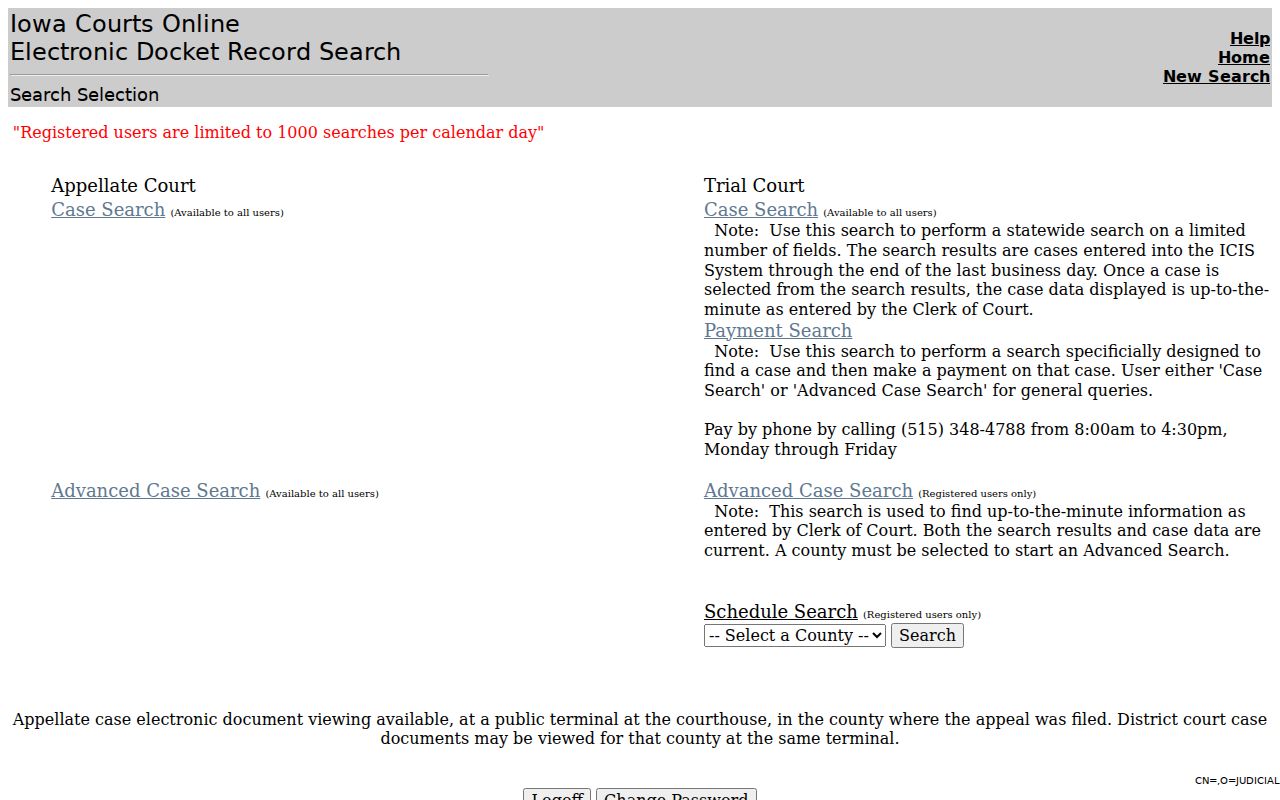
The search result is a court index. It does not supply a police narrative, live custody confirmation, or every filed document.
| Search control | Type | Required | Format or use |
|---|---|---|---|
| Last or firm name | Text | Yes for name search | Enter at least two letters; the percent sign is the wildcard. |
| First name | Text | Optional for name search | Do not put a period after a first initial. |
| Date of birth | Date | Yes for DOB search | Exact DOB, first name, and last name are required; no wildcard in those fields. |
| County and case type | Select | Yes for case ID | Choose Clarke and the matching public case category. |
| Case ID | Text | Yes for case ID path | Use all 17 characters; uppercase letters and zero are exact. |
| Citation number | Text | Yes for citation path | Enter the citation number shown on the source document. |
Clarke County Docket Search Limits
A newly entered case may take one business day to appear. Clerk-filed documents can take longer even when later docket data is described as real time. The payment interface warns that a citation can take 14 to 21 days to appear. City parking tickets not filed with a county clerk, confidential or juvenile cases, unconverted older records, and very recent citations may not be present.
The free public docket is enough for many name and case-ID searches. Advanced Search adds schedule criteria, judgments and liens, exhibit lists, bonds, service returns, expanded party detail, and complete financial views. Registration costs $25 per month. It still does not grant electronic access to public filings, and it cannot be used to pay court costs.
The official Advanced Search registration screen shows the subscription fields and price.
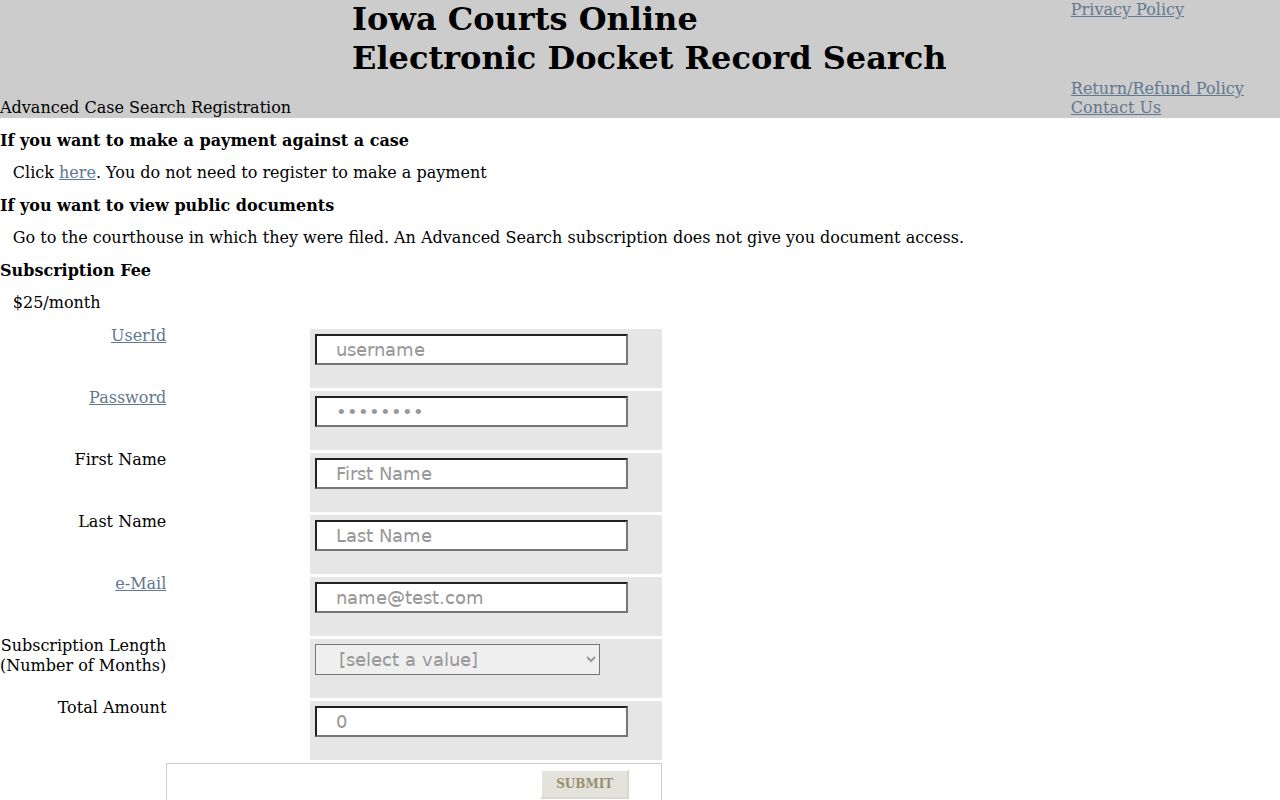
The screen confirms that a paid search account buys broader index tools, not courthouse document access.
The case and citation payment search has separate controls and delay notices.
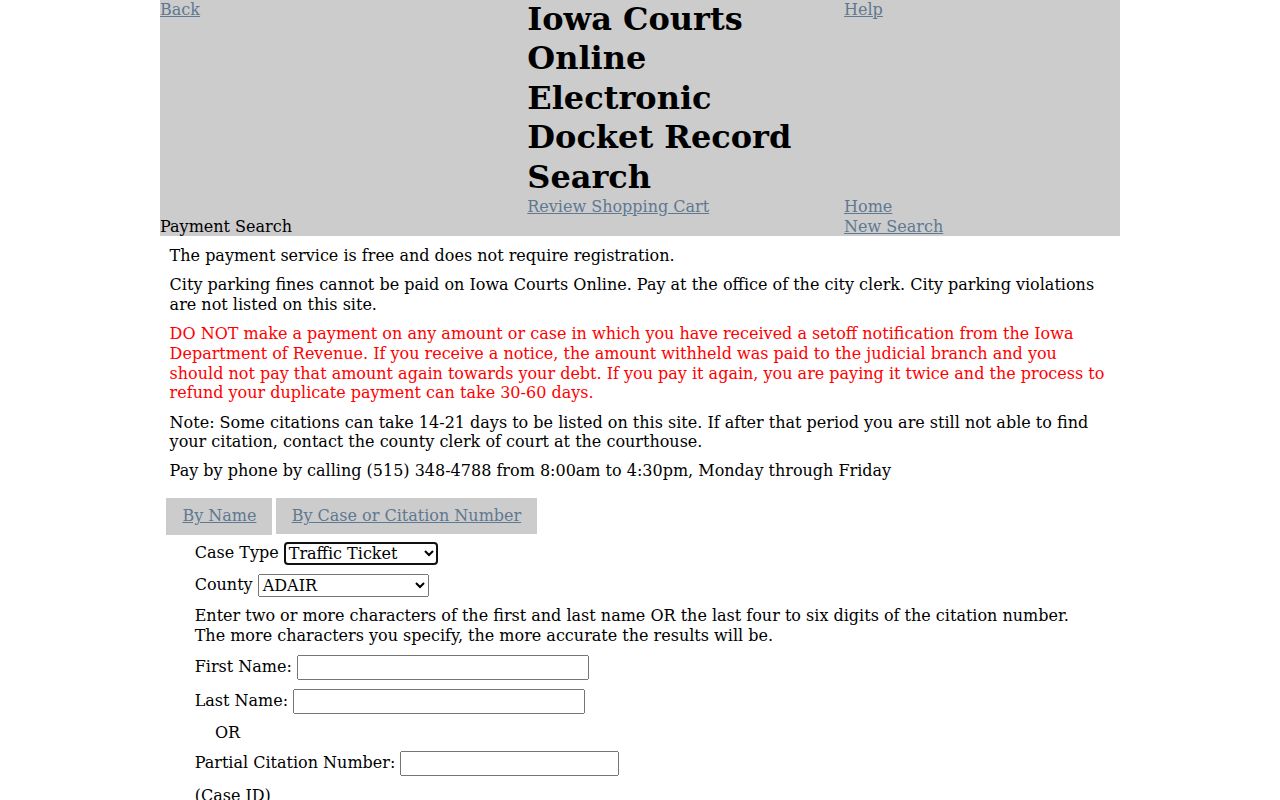
Use that screen for payment-related lookup, but return to the docket and clerk when the goal is to understand the full case history.
Technical help is available at 1-800-831-1396, Monday through Friday from 7 a.m. to 5 p.m., except holidays. A missing online case can also call for a clerk inquiry, particularly when the matter is older, newly filed, restricted, or entered under a different name form.
What the Clarke County Case File Shows
A case file records what prosecutors filed and what the court did. It is not a statement that every allegation at arrest was true. The summary identifies the case, while the charges and filings show how the legal theory changed. The disposition and judgment state the outcome. Public financial modules can show fines, costs, surcharges, restitution, and payment history where released.
| Case number and court | County, case ID, case type, title, created or opened date, status, and indexed judge. |
|---|---|
| Parties and counsel | State of Iowa, defendant, party role and status, and lawyers where public. |
| Charging document | Complaint, trial information, or indictment where applicable, plus filed or amended counts. |
| Docket entries | Filings, pleas, motions, hearings, orders, judgment, sentence, and appeal notices. |
| Charges and disposition | Code, description, offense level, defendant, outcome, and disposition date for each count. |
| Sentence and financials | Judgment terms and public fine, cost, surcharge, restitution, payment, and balance entries. |
Public bond modules can include the set and posted amounts, date, type, poster or agent, disposition, and service details. Scheduling can identify an event date, time, officer, and court location. Protected documents, expunged cases, juvenile material, and unserved-warrant proceedings can be absent or limited.
Note: A docket entry can identify a filing even when its image or full text is available only through the courthouse.
Clarke County Charges and Custodians
The arresting agency writes the incident or arrest report. The jail records intake. Clarke County Attorney Johanna Olson decides what the state will prosecute, while the clerk opens and maintains the court file. These roles explain why the booking charge and filed charge may differ. Prosecutors can decline, amend, replace, or consolidate allegations before a final disposition.
The Clarke County Attorney's official page identifies the office's duties and public contact.
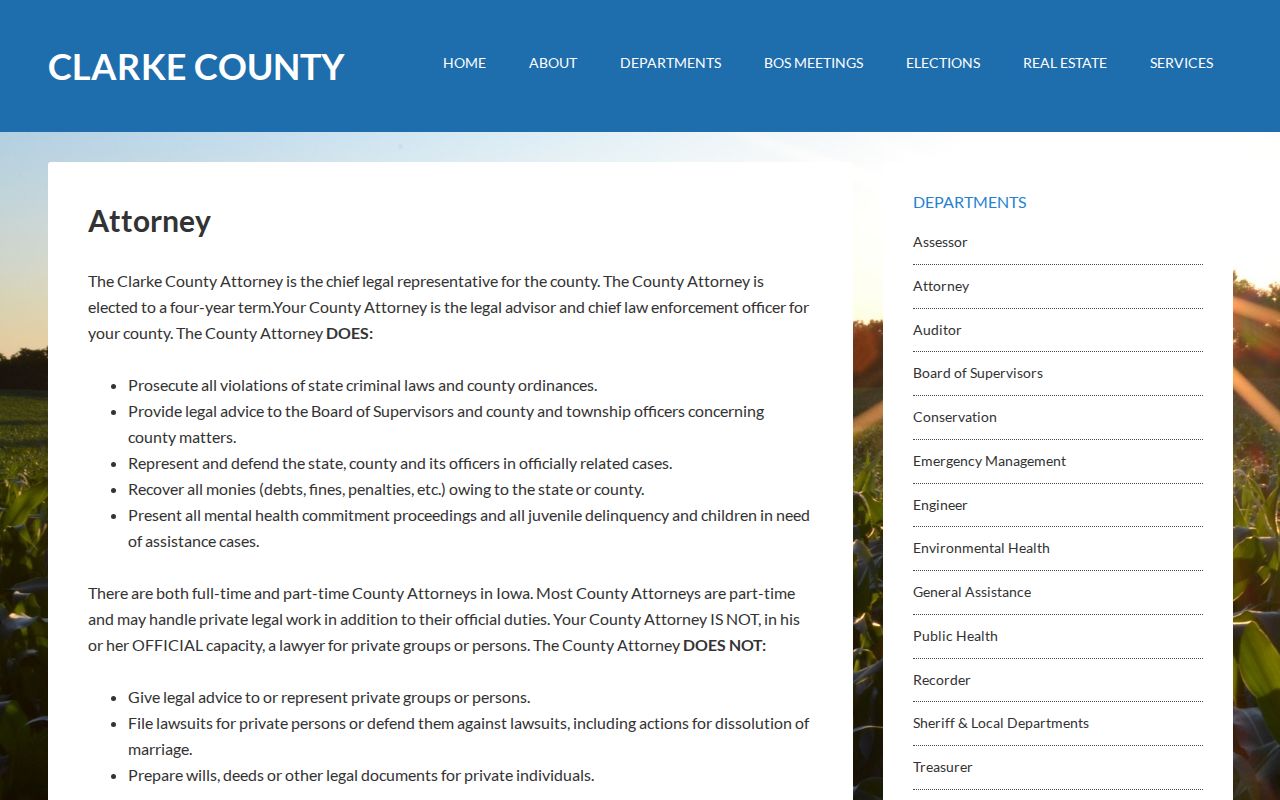
The county attorney prosecutes state crimes and county ordinances, handles juvenile and commitment matters, advises county government, and represents the state and county. The office does not act as a private lawyer.
For the police narrative, contact the agency that created it. For the filed case, disposition, judgment, and certified papers, contact the clerk. For a statewide fingerprint-linked history, contact Iowa DCI. A person seeking appointed defense follows the court's application and appointment process; the appointment order normally identifies counsel.
Stages of a Clarke County Criminal Case
A local criminal case can begin with an arrest or complaint, followed by a prompt initial appearance and release or bond decision. The prosecutor then files, declines, or amends the formal charge. At arraignment, the charge is stated and a plea is entered. Discovery and motions shape the pretrial stage. A plea or trial produces the disposition, followed by judgment and sentence when there is a conviction.
Case flow: Charges Filed → Arraignment → Pretrial → Plea or Trial → Disposition → Sentencing
Later entries may record an appeal, probation violation, restitution issue, correction, or expungement proceeding. A docket therefore grows over time. The first listed charge should not be treated as the final outcome, and the initial booking date should not be confused with the filing, plea, disposition, or sentencing date.
- Arraignment
- The hearing at which the charge is stated and the defendant enters a plea.
- Trial information
- An Iowa prosecutor-filed charging instrument used for indictable offenses.
- Disposition
- The recorded outcome of a charge or case, such as dismissal, acquittal, plea, or verdict.
- Deferred judgment
- An Iowa process that withholds judgment while required conditions are completed.
No Clarke County Municipal Criminal Courts
Osceola, Murray, and Woodburn do not operate municipal criminal case portals. Iowa's Unified Trial Court Act ended inferior municipal trial courts effective July 1, 1973. State-law, traffic, and city-ordinance prosecutions route into Iowa District Court as jurisdiction allows. Searching for an Osceola municipal criminal docket can therefore lead a reader away from the real file.
Use Clarke County in Iowa Courts Online and contact the Clerk of District Court for the public documents. City offices may hold administrative records, and Osceola Police holds its own incident reports, but neither source becomes a separate municipal criminal court. Murray and Woodburn have no identified municipal police or court portals.
Magistrate sessions are part of the same unified Iowa court system. Fifth District Administrative Order 2025-46 designates Tuesday availability in Clarke County during 2026, from 9:30 a.m. to 4:30 p.m., except legal holidays or approved changes. Confirm the specific event through the docket or clerk.
Clarke County Case Access and Restrictions
Iowa court records begin with a strong public-access principle, but the public view is not unlimited. Juvenile cases can be confidential under chapter 232. Court-ordered expunged or sealed cases are restricted. Victim identifiers, Social Security numbers, account data, medical details, and safety-sensitive addresses can be redacted. Search-warrant and outstanding-warrant matters may remain confidential until service or execution conditions are met.
The Iowa Open Records Law does not override every court restriction. Court files also follow judicial administrative rules. Remote docket access can expose less than the public courthouse file, while some material remains unavailable in either place. Ask the clerk about the status of a case that does not appear and avoid assuming that absence means the event never occurred.
Access point: Iowa Code chapter 22 supports access to public records, while court rules and other statutes control confidential filings, redaction, and restricted cases.
A certified copy comes from the clerk, not from a screenshot of the online docket. When a case affects your own record, ask for the exact disposition and any order that changes public access. If an Iowa DCI entry later appears inaccurate, use DCI's subject challenge process rather than asking the clerk to alter the state repository directly.
Reading Clarke County Case Outcomes
Read each count separately. One case can contain a dismissed charge, an amended charge, and a conviction on another count. A dismissal means that charge ended without a conviction. An acquittal is a not-guilty determination. A plea is the defendant's formal response, while a plea agreement is a negotiated resolution subject to court procedure. The judgment and sentence follow a conviction.
Financial entries need context. A listed obligation may combine a fine, surcharge, court cost, restitution, or another assessment. Paid and due amounts can change after the disposition. Bond fields document release security and later bond disposition; they do not state guilt.
Compare the filed charge with the final disposition and date. Then read the judgment and sentence entries. If the wording or code is unclear, inspect the public filing at the courthouse or request a copy. The broader Clarke County criminal history overview explains why the court outcome can differ from the arrest report, booking record, and DCI history.
Expungement under chapter 901C is narrow and case-specific. A qualifying order makes the court record confidential under the remedy, but should not be described as erasing every agency trace. Registry duties also follow separate law.