
How to Check Criminal History in Clarke County
Begin with the record that answers the question. Filed criminal charges, hearing events, judgments, and court debt belong to the Clerk of District Court. An incident narrative belongs to the agency whose officer wrote it. A booking entry belongs to the Clarke County jail. The Iowa Department of Public Safety, Division of Criminal Investigation keeps a separate statewide history built around fingerprint-supported arrest cycles and reported dispositions. These sources can differ because each records a different stage.
Gather the full legal name, exact date of birth when it is lawful to use, likely name variants, and an approximate event or filing date. A case number, citation number, report number, or booking number is even better. Then use the narrowest official channel first. Broader searches can produce false matches, especially when names are common.
- Search Iowa Courts Online for a public Clarke County docket by name, case ID, or citation number.
- Open the matching case and compare the county, case type, filing date, charges, and disposition rather than relying on the name alone.
- Call the clerk for courthouse document inspection, an archived file, a certified copy, or a status that is unclear online.
- Contact the arresting agency or sheriff for the incident report, booking entry, present custody, or local warrant verification.
- Order the Iowa DCI product when an Iowa-wide repository check is needed, then verify disputed or missing details with the original office.
Clarke County has no verified sheriff records portal, public jail roster, booking-photo gallery, or active-warrant list. That gap changes the search order. Use the telephone, agency counter, a focused Iowa open-record request, and the court docket instead of substituting an unofficial people-search source.
Two Clarke County Record Buildings
The county's public record path divides between two Osceola locations. The Clarke County Courthouse at 100 South Main Street holds the clerk, court files, public courthouse terminal, certified court copies, expungement filings, and the county attorney. The Clarke County Law Enforcement Center at 220 Townline Road holds the sheriff and Osceola Police. It is the local route for incident reports, bookings, jail questions, and warrant confirmation.
The Clarke County government gateway shows the public starting point for county offices.
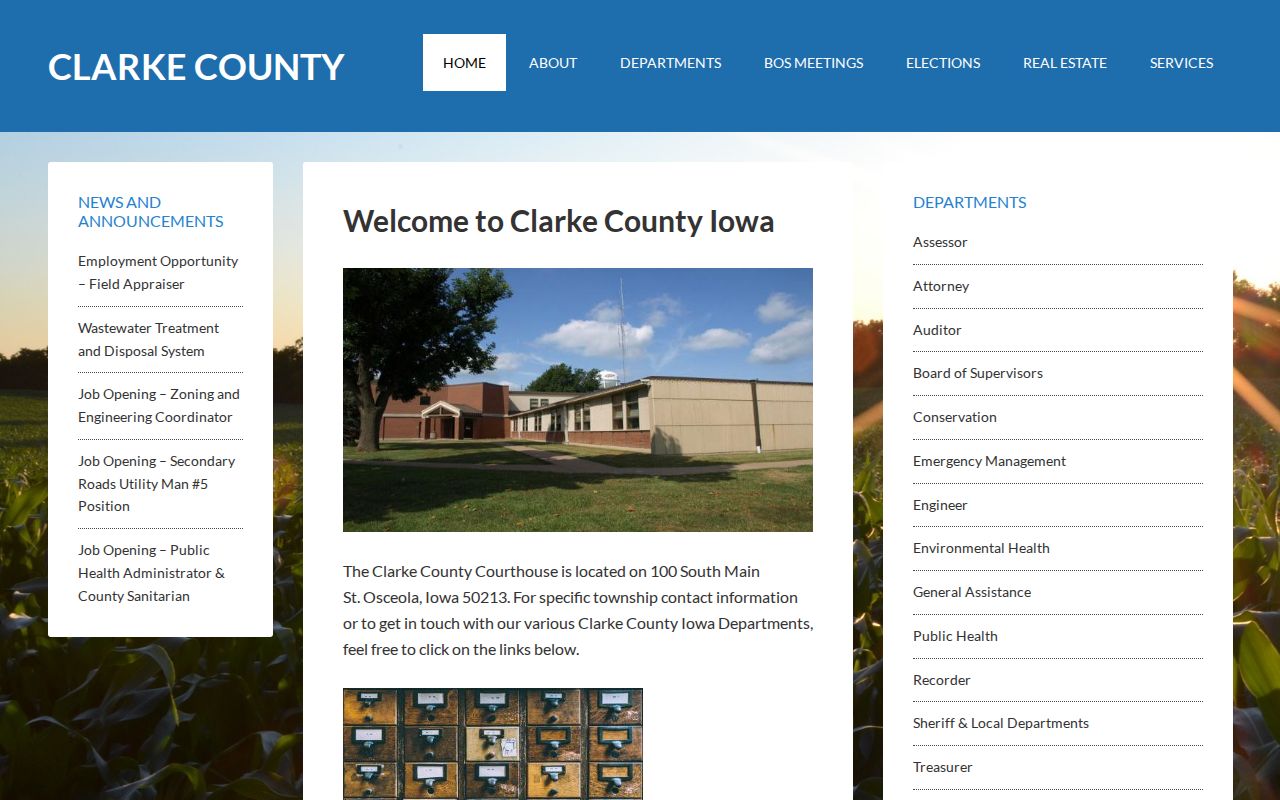
That gateway is useful for finding the custodian, but it is not a combined criminal-history database.
The county's justice office directory places the clerk, sheriff, and county attorney contacts in one official source.
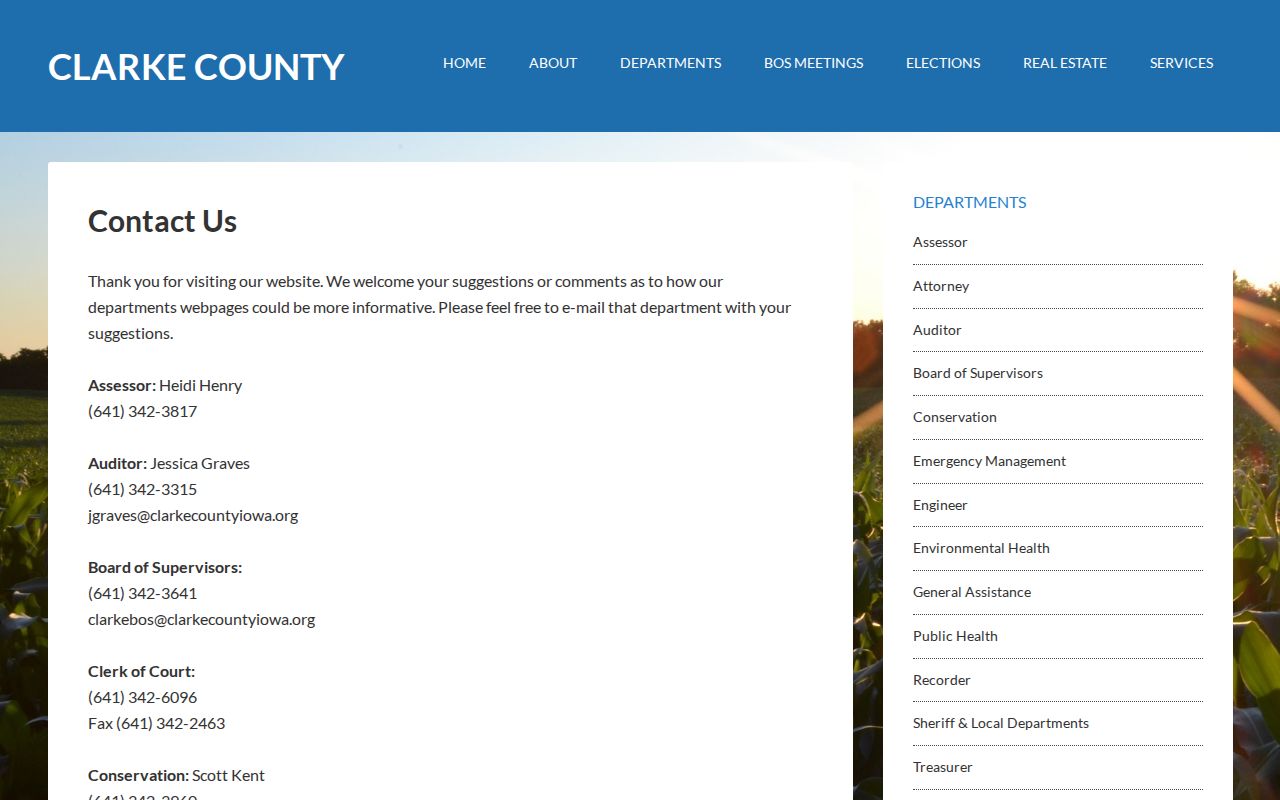
The directory helps prevent a common error: asking the clerk for an officer's narrative or asking the sheriff for a certified judgment.
Clerk of District Court
100 S. Main St.
Osceola, IA 50213
641-342-6096
Filed cases, courthouse documents, certified copies, and court orders.
Sheriff's Office
220 Townline Rd.
Osceola, IA 50213
641-342-2914
Bookings, jail status, sheriff reports, and warrant confirmation. Call before visiting.
Official Iowa Background Checks
The Iowa DCI Criminal History Record Dissemination Unit provides the official Iowa name-based record check. The request needs a first name, last name, and exact date of birth. Gender is required on the form, while a middle name and Social Security number can help distinguish people with similar names. The fee is $15 for each last name, so each separate last name requires its own request and payment.
Online submissions normally take one to three days, depending on workload. Mail, fax, email, and in-person channels are also documented, with both a request form and billing form required. Iowa does not require the subject's release for every request, but a signed release can expand what DCI may disclose. It matters for a discharged deferred judgment. Telephone requests are not accepted.
The DCI criminal-history information page sets out the official channels, fee, forms, and interpretation rules.
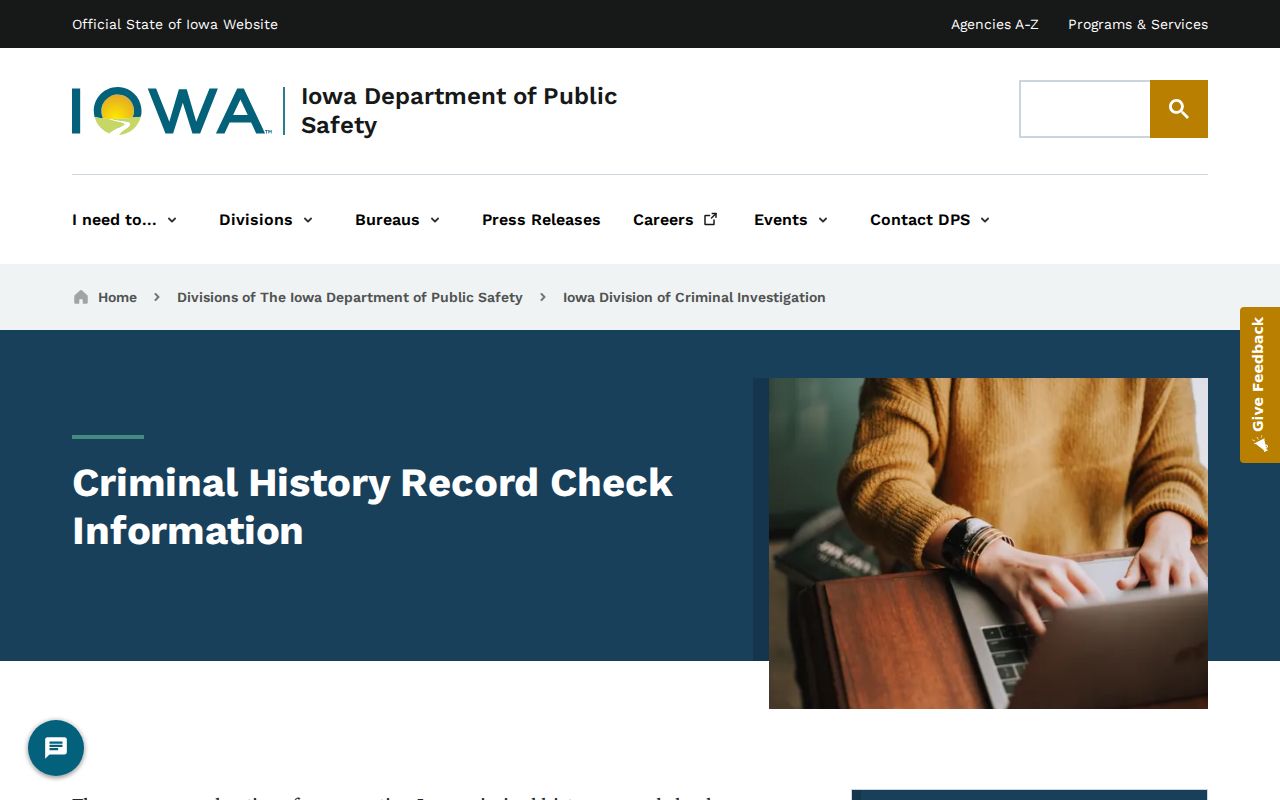
Its instructions make clear that the result is an Iowa repository product, not a certified Clarke County court file or a national record.
| Field or item | Status | What to know |
|---|---|---|
| First and last name | Required | Each last name needs a separate $15 request. |
| Exact date of birth | Required | Use the full date to reduce false matches. |
| Gender | Required on form | Choices are M, F, or Other. |
| Middle name or SSN | Recommended | These fields can improve identity resolution. |
| Signed release | Conditional | It changes access to some nonconviction data and a discharged deferred judgment. |
| Delivery choice | Required | Mail, fax, or email options depend on the submission route. |
For a person's own national fingerprint record, the FBI Identity History Summary is the relevant subject-only process. Iowa DCI maintains the state fingerprint repository, and the Clarke County Sheriff's Office confirms fingerprinting by appointment. A fingerprint appointment alone does not order a DCI or FBI result, so ask which steps and current fees apply.
Why Clarke County DCI Records Have Gaps
A DCI result depends on what entered the repository and what Iowa law permits DCI to release. Fingerprints create the key link. If fingerprints were not taken and sent on an arrest, DCI says that arrest will not appear in its criminal-history file. Most simple misdemeanors, minor traffic matters, federal cases, other states, and the FBI's national file also fall outside this public Iowa product.
The DCI online request interface is the official electronic submission point.
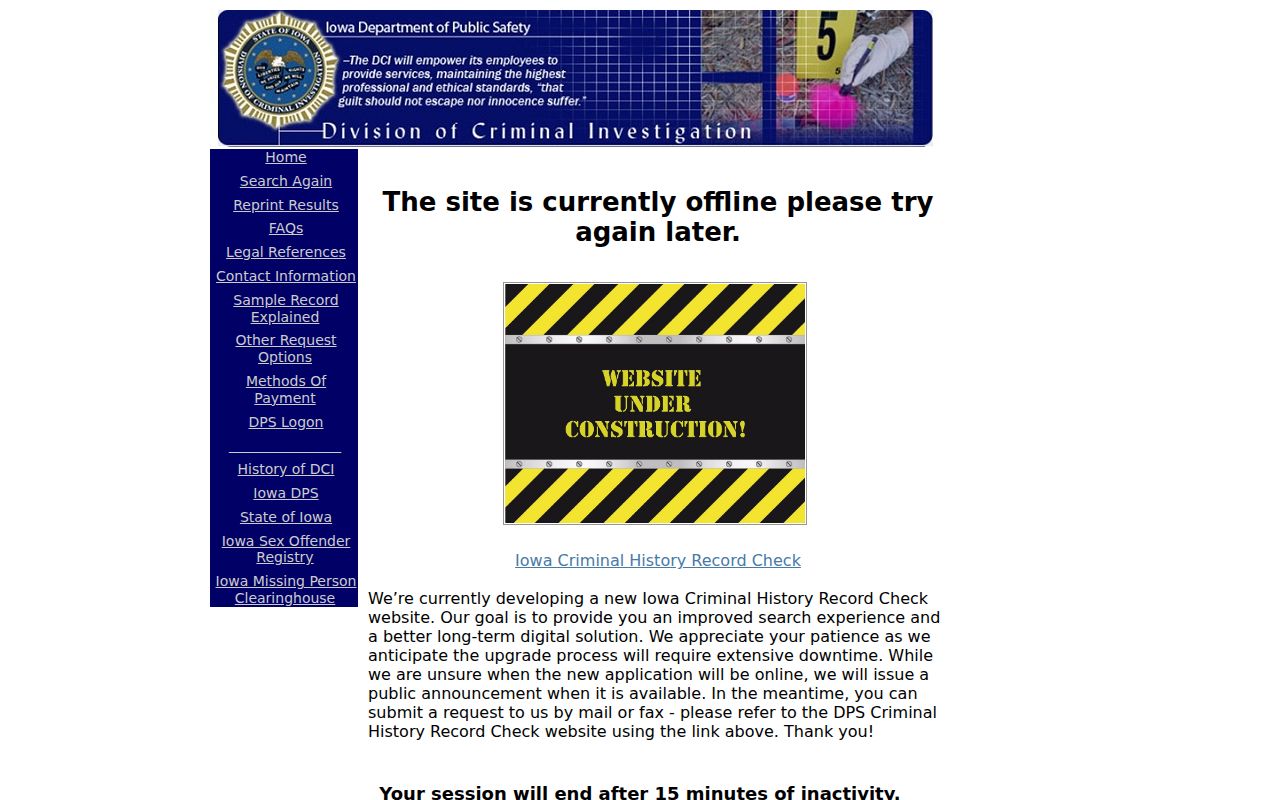
The form gathers identity and delivery details, but the response still reflects Iowa's disclosure rules and repository coverage.
The official DCI record coverage FAQ explains why a negative response has more than one possible meaning.
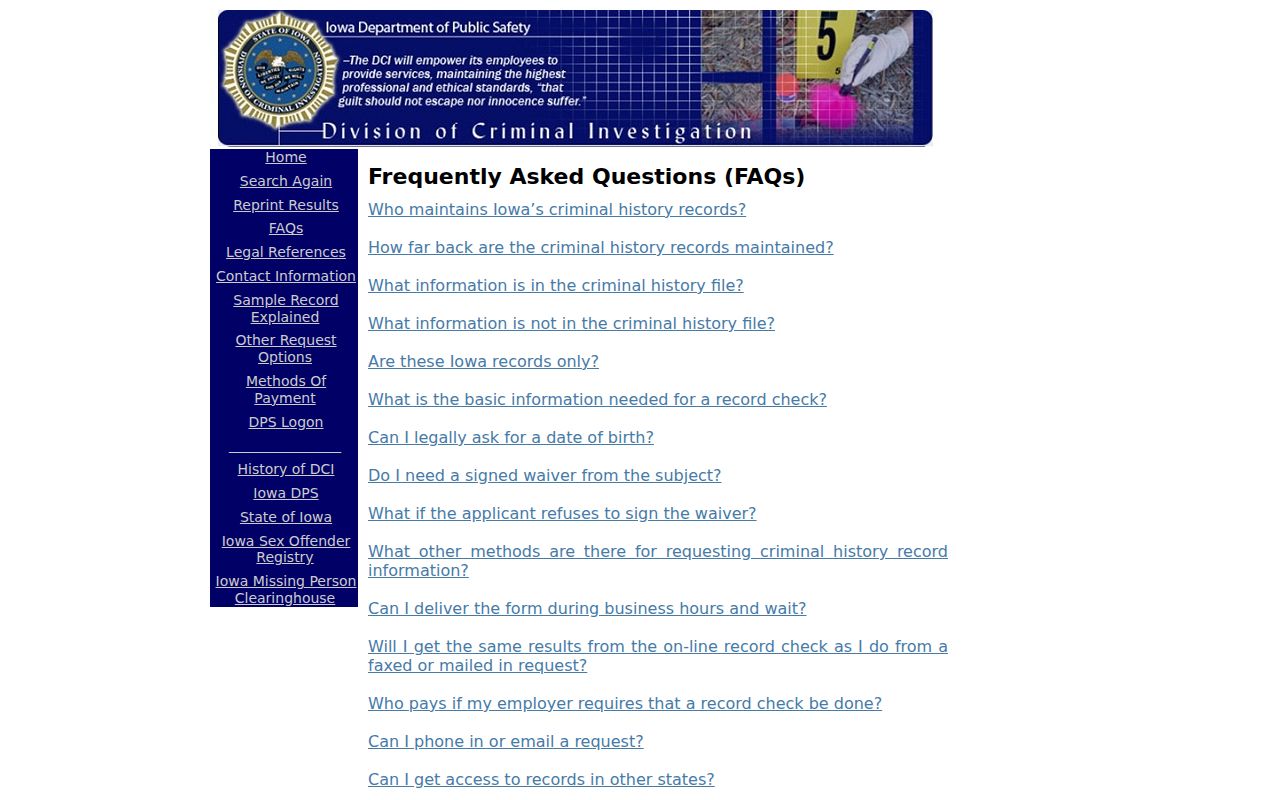
“No Iowa Criminal History Found with DCI” can mean no file exists, only confidential juvenile information exists, or information is not releasable under the request conditions. A Clarke County court docket may still exist.
Clerks and justice agencies report dispositions back to DCI. When an arrest has no disposition after four years, DCI states that it must purge that arrest from its criminal-history file. Delayed or unmatched reporting can therefore make a repository record differ from a courthouse docket. Compare both before concluding that one source is wrong.
Types of Criminal Records in Clarke County
Criminal records document different events, and their custodians do not merge them into one file. The record type determines which office can answer the request and which limits apply.
- Incident and arrest reports: The sheriff, Osceola Police, or Iowa State Patrol records the officer's account, alleged conduct, time, place, and initial charge.
- Booking and jail records: The Clarke County jail records custody intake, holds, bond, and release, but no official web roster was found.
- Criminal court files: The clerk records the filed charge, motions, hearings, plea, outcome, sentence, and public financial entries.
- DCI criminal history: The state repository compiles fingerprint-linked Iowa arrest cycles and releasable dispositions under chapter 692.
- Warrant, supervision, and registry records: Courts, law enforcement, community corrections, DOC, and DCI keep separate purpose-built records.
A booking charge can change before prosecution. The county attorney may decline, amend, or replace it. Later, the court records the judicial result while DCI receives a reported disposition. This is why dates and charge labels can vary across an arrest report, booking entry, case file, and rap sheet without proving fraud or error.
Clarke County Warrant Record Fallback
No official Clarke County active-warrant portal or most-wanted database was located. Call the Clarke County Sheriff's Office at 641-342-2914 for current verification. Contact the clerk at 641-342-6096 about the public court case, and review Iowa Courts Online for visible docket events. A narrow chapter 22 request may help when an existing open record is not routinely supplied by phone.
An arrest warrant authorizes custody. A bench warrant often follows a failure to appear or comply. Search warrants concern evidence and can remain confidential before execution. Juvenile, sealed, and unserved matters may also be restricted, so no online hit is not a clearance certificate.
If a warrant may concern you, obtain the case number, issuing court, bond or appearance instructions, and current status from the sheriff or clerk. Follow the issuing court's direction. Keep any recall order or receipt and reconfirm because updates can take time to move between court and law-enforcement systems.
Note: Paying unrelated court debt does not automatically recall a Clarke County warrant or cancel a required court appearance.
What a Clarke County Criminal Record Shows
A court file and a rap sheet use different structures. The DCI record centers on identity and fingerprint-supported arrest cycles. The Clarke County court file centers on a case ID, filed counts, events, orders, outcome, sentence, and public financial data. A jail entry centers on intake and custody. Read the field names before comparing results.
| Name and identifiers | Legal name, aliases, date of birth, sex, and state identification or fingerprint linkage where the product permits. |
|---|---|
| Arrest or booking data | Arrest date, agency, intake time, initial charge, holds, bond, and release data held by the proper custodian. |
| Charges and statutes | Alleged or filed offense, code reference, offense level, filing date, and later amendments. |
| Disposition | Dismissal, acquittal, guilty plea, verdict, deferred judgment, or another recorded outcome. |
| Sentence | Confinement, probation, fine, restitution, court costs, and related judgment entries where public. |
| Custody or supervision | County jail status, state correctional status, or community supervision held in separate systems. |
Some terms have a narrow legal meaning. A disposition is the outcome of a charge. A deferred judgment withholds judgment while set terms are completed. Expungement makes qualifying Iowa court records confidential under a defined law; it should not be described as the physical destruction of every agency trace.
Clarke County Custody Record Routes
Current custody cannot be inferred from an old sentence. For a recent Clarke County booking or short local sentence, call the sheriff because no official public jail roster was found. For a person in the state correctional system or a public community-corrections status, use the state corrections locator. Federal custody has its own Bureau of Prisons system.
Custody route: Clarke County jail for local custody › state corrections locator after a state transfer › federal locator for federal custody › court docket for the case outcome.
These systems answer distinct questions. A docket can show bond, sentencing, or a revocation event without proving where someone is housed today. A custody notification service can send status alerts, but it does not replace the official court disposition. Fifth Judicial District community corrections holds detailed supervision material, much of which is not a general public case file.
Clarke County is rural, and the Census QuickFacts profile supplies useful scale and access context.
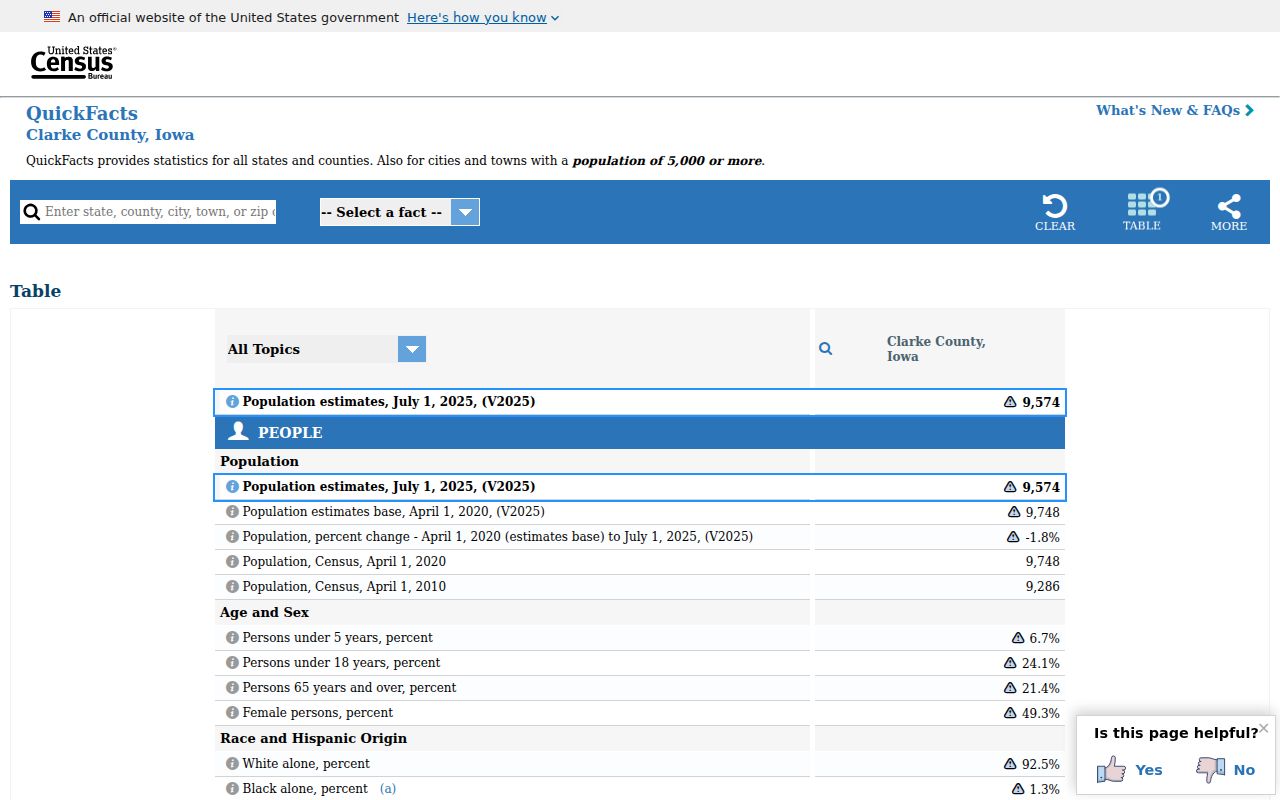
The 2025 estimate is 9,574 residents across 431.11 land square miles. Those facts help explain why direct phone routing remains important, but they must not be used to infer crime or guilt.
Public Access Laws for Clarke County Criminal Records
Iowa law begins with a right to examine and copy public records, but it also protects defined categories. The custodian must assess the exact record. A sheriff report can contain both open facts and confidential investigative material. A court file may be public while a juvenile case, victim identifier, sealed filing, or unserved-warrant matter is restricted. DCI disclosure follows its own criminal-history statute.
Key Iowa laws:
Iowa Code §22.2 gives every person a right to examine and copy public records unless another law makes them confidential.
Iowa Code §22.3 permits lawful, reasonable retrieval, supervision, and copy costs.
Iowa Code §22.7 lists confidential categories that can require withholding or redaction.
Iowa Code §692.5 supports subject access and a process to challenge inaccurate repository information.
Ask for an existing record rather than requiring an office to create a new analysis. State the date range, place, agency, and known identifier. Request electronic delivery and an estimate before costs exceed a set amount. The office can then separate open material from protected data.
Clarke County Criminal Record Requests
The sheriff does not publish a dedicated records email, fax number, request form, fee schedule, or counter hours. A focused Iowa Open Records Law request is the reliable fallback. Address it to the record custodian at the Clarke County Law Enforcement Center and identify whether the desired item is an incident report, arrest report, booking record, jail log, CAD entry, 911 audio, body-camera file, or warrant record.
Include the approximate event date and time, event location, suspected agency, and report, case, or booking number if known. Supply contact and delivery details, then ask for an advance cost estimate. The office may redact protected victim, juvenile, medical, personal, investigative, or security-sensitive information. Phone contact helps route and narrow the request, though it may not be the delivery channel.
Osceola Police uses the same Townline Road building but remains custodian of its own police reports. The Iowa State Patrol keeps patrol-created arrest and crash records. Murray and Woodburn have no identified municipal police departments, so their documented law-enforcement route begins with the sheriff.
Sealed, Expunged, and Restricted Records
Iowa expungement is remedy-specific. Chapter 901C covers qualifying acquittals and dismissals subject to its prerequisites and exceptions. It also provides a limited, generally one-time path for certain misdemeanor convictions after the required period and satisfaction of the judgment. Iowa does not allow routine expungement of all convictions or felonies.
The official Iowa expungement chapter contains the controlling current sections.
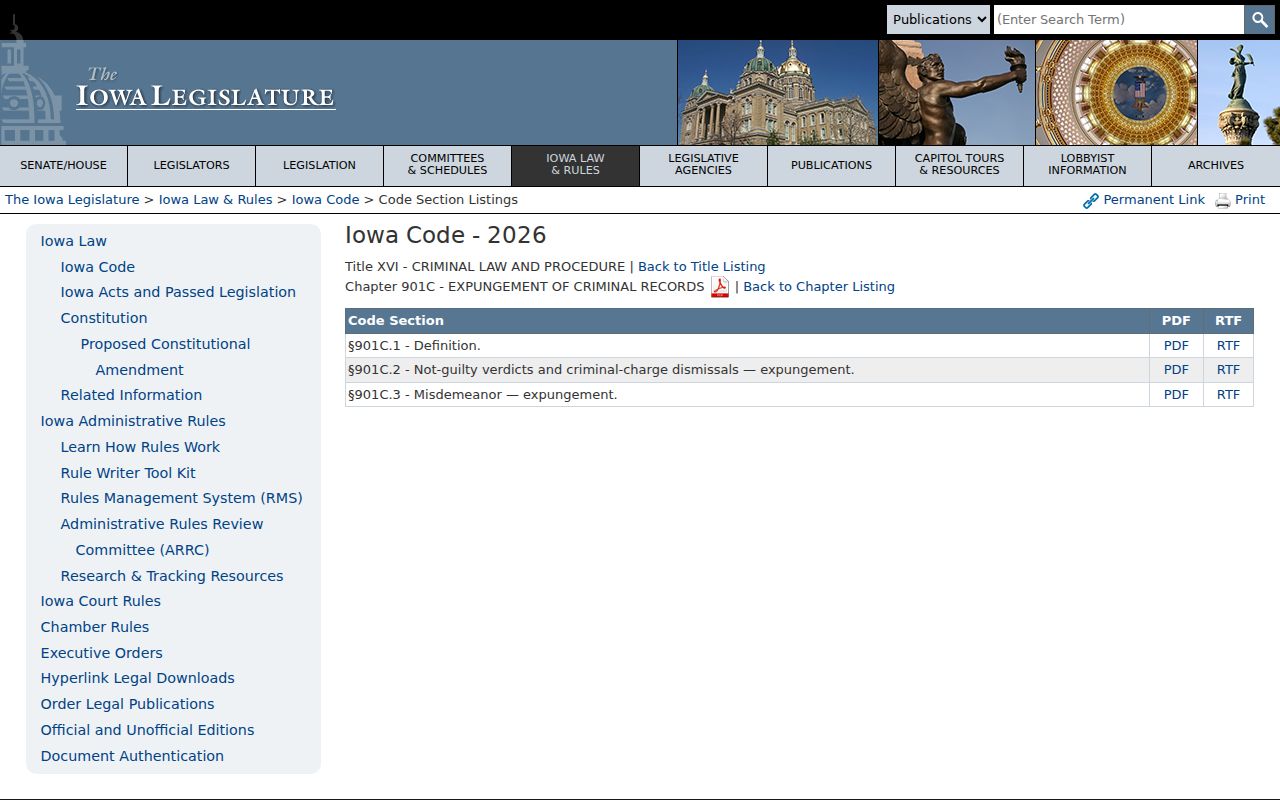
A Clarke County applicant should identify the case, read the current subsection and exclusions, use the matching Judicial Branch form, and file through the Clerk of District Court. The court grants judicial expungement, not DCI or the sheriff.
After an order, check the public docket treatment and request your own DCI result. Use the DCI challenge process if inaccurate data remains; fingerprints may be required to confirm identity. Juvenile records follow chapter 232, and outstanding warrants can remain restricted. Registry duties are separate, so expungement alone does not end a chapter 692A registration requirement.
Clarke County Probation and Parole Records
The Fifth Judicial District Department of Correctional Services serves Clarke County with probation, parole, pretrial supervision, drug treatment court, electronic monitoring, residential services, work release, and other programs. The Iowa Board of Parole makes parole release decisions. Iowa DOC and district community corrections carry out supervision.
No standalone public Clarke County probation lookup was verified. Use the court docket for the sentence or revocation case, the state correctional search for public status, and Fifth District staff for information they may lawfully release. Detailed assessments, treatment notes, addresses, conditions, and officer-safety information may remain restricted.
The official Iowa Board of Parole site explains the decision-making layer.
A parole decision is not the same record as a current supervision entry, a prison location, or the sentencing docket. Confirm each status with its custodian.
Criminal Records by City in Clarke County
Clarke County's three incorporated cities are Osceola, Murray, and Woodburn. Osceola has the county's only identified municipal police agency, but its cases still run through Iowa District Court because Iowa abolished municipal trial courts. Murray and Woodburn use the sheriff route for criminal incidents and bookings. City administrative records remain with the relevant city office.
Osceola Criminal History
Population 5,415 in the 2020 Census. Osceola Police writes city reports; the sheriff handles county booking.
Murray Criminal History
Population 684 in the 2020 Census. The documented criminal-record route begins with Clarke County Sheriff.
Woodburn Criminal History
Population 186 in the 2020 Census. Sheriff records and District Court replace a local police or court portal.
The city pages distinguish police or sheriff records from county court files. They also identify where city administrative requests belong, without inventing municipal criminal courts or local booking databases.
Clarke County Federal Criminal Records
Federal matters use a separate system. Clarke County lies in the U.S. District Court for the Southern District of Iowa. PACER provides federal dockets and filed documents through an account. The federal Bureau of Prisons locator covers federal custody, while the FBI Identity History Summary is a subject-only fingerprint process for a person's own national file.
The Southern District of Iowa identifies the federal court serving Clarke County.
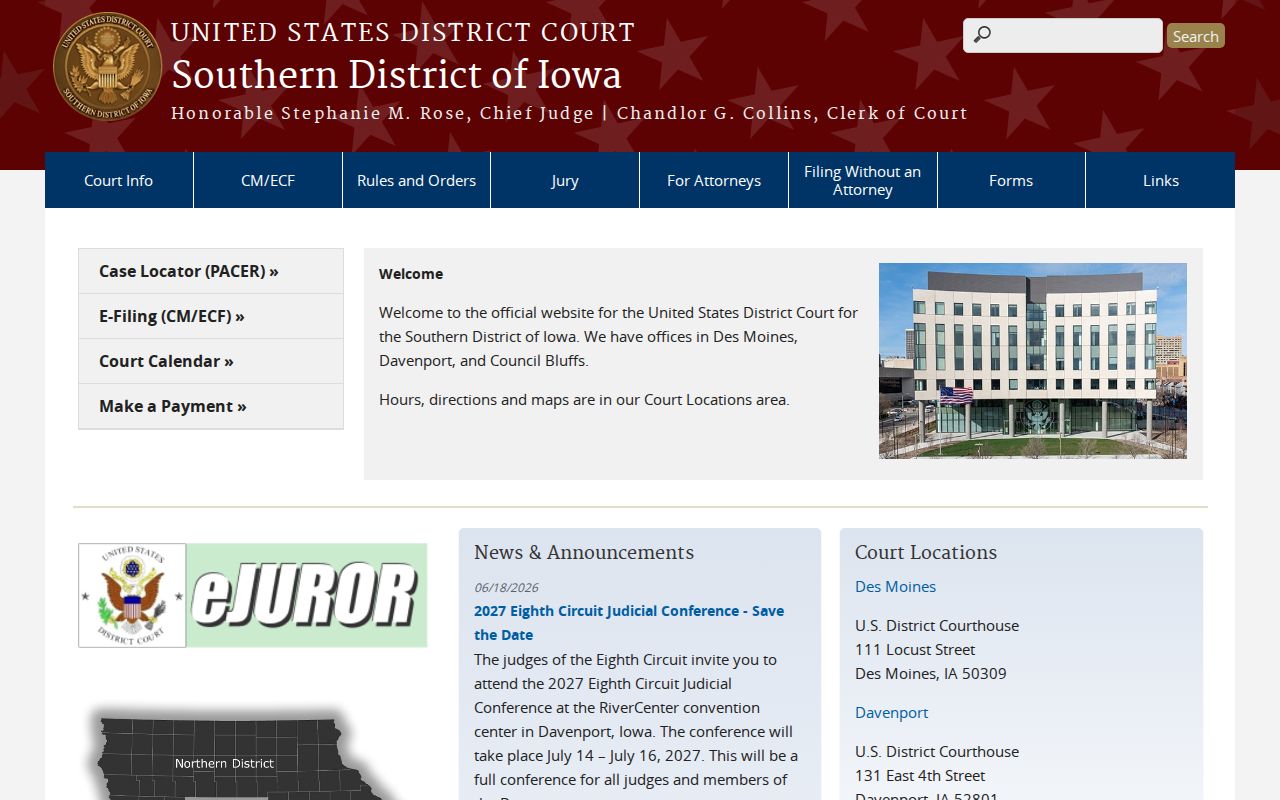
A federal case does not appear in the Iowa DCI public check merely because the conduct took place in Iowa. Search the federal docket directly.
PACER normally charges by the page, caps many documents, and waives a quarterly bill at or below its stated threshold. Rates and exceptions can change, so confirm them before ordering. No federal prison was identified within Clarke County.